Building a Chrome Extension for Jira: Colored History Diffs and Layout Toggles
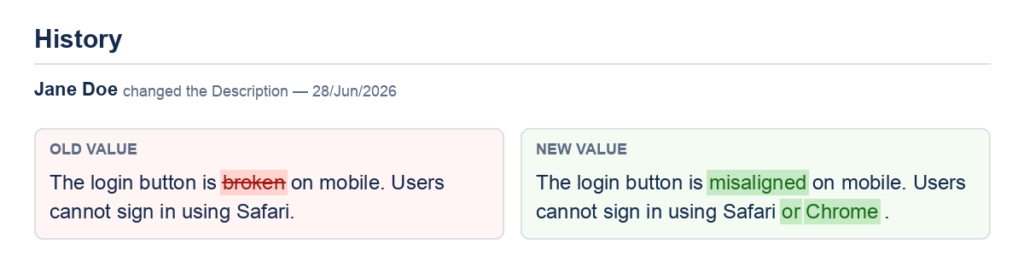
How the extension renders a Description change in the History tab — removed words in red, added words in green. […]
How the extension renders a Description change in the History tab — removed words in red, added words in green. […]
Sometimes a project starts with a simple wish: I wanted to extend my STM32F407 Discovery board with a 2.4" touchscreen
Over the last several updates, Rainbow-OS went on a diet. One by one, the things that had been compiled into
Last time, Space Invaders became the first Rainbow-OS program to live outside the kernel. Getting it there was real work:
For most of its life, every „app“ in Rainbow-OS — the editor, the BASIC interpreter, the C compiler, the games
Once Rainbow-OS could compile C and run it in Ring 3, the obvious next question was: how do you watch
Until recently, every program Rainbow-OS ran shared one address space with the kernel, at full privilege. A program compiled with
After Asteroids, Rainbow-OS gets its second arcade classic: a full Space Invaders, launched with the invaders shell command and running
With a 256-color graphical console in place, Rainbow-OS was finally ready for the obligatory rite of passage for any hobby
Rainbow-OS has spent its whole life talking to the screen through the PC’s oldest trick: VGA text mode, an 80×25